
A robot’s network connection can recover while the information arriving through it is already outdated. A command can reach its destination while the operator remains uncertain whether it was executed. A camera feed can remain smooth while showing the scene too late to support a useful decision.
Remote robotics brings these requirements together: fresh telemetry, explicit command outcomes, and timely video and audio. Each has a different relationship with loss, delay and recovery.
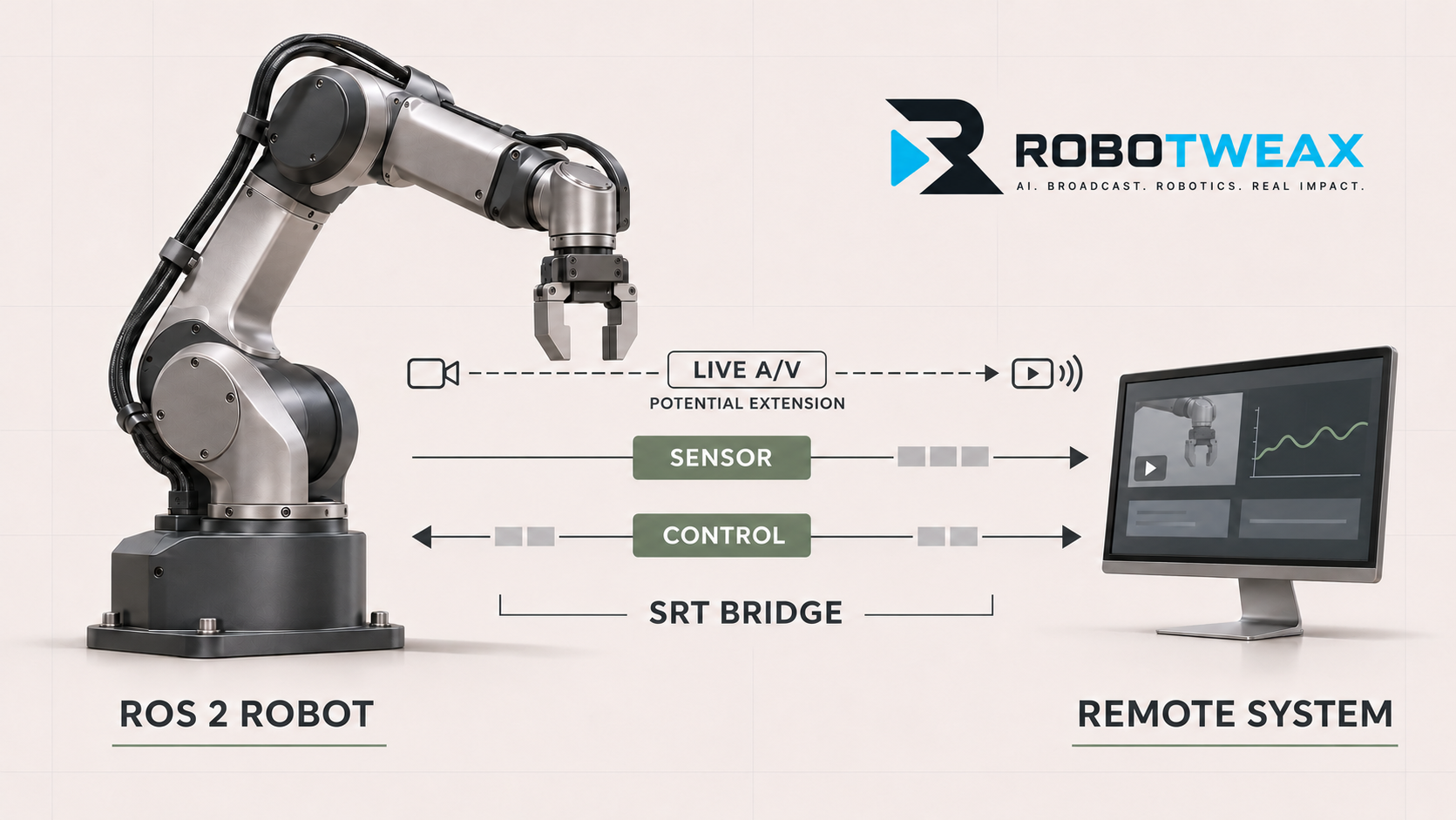
We created the Robotweax ROS 2 SRT Bridge to make the telemetry and command contracts explicit and testable across an impaired connection. SRT’s established media capabilities also offer a compelling opportunity for a separate live A/V extension.
SRT—Secure Reliable Transport—is best known for carrying live video and audio across unpredictable networks. It supplies UDP-based transport, packet-loss recovery, configurable delivery timing and payload encryption. SRT protocol overview.
That UDP foundation matters when information has a useful lifetime. TCP provides a reliable, ordered byte stream: if a segment is lost, later bytes in the same stream must wait for the gap to be repaired before they can be delivered to the application in order. This head-of-line blocking can hold back a newer sensor reading or video data even when it has already arrived. TCP’s completeness and ordering are valuable when every byte is required, but waiting for older data can work against freshness. TCP delivery semantics.
UDP does not impose that reliable, ordered byte-stream contract. A protocol built on it can define when to recover missing data and when to move on. SRT adds recovery mechanisms: Automatic Repeat reQuest, or ARQ, recovers missing packets through retransmission; Forward Error Correction, or FEC, adds redundancy that can reconstruct certain losses at the receiver. For live media, SRT can also abandon packets that miss their delivery window when too-late packet dropping is enabled. This allows recovery to be balanced against timeliness. SRT protocol specification.
The advantage is control over recovery and delivery policy; UDP alone does not guarantee lower latency. SRT’s ordering, retransmissions and buffering can still introduce waiting. In our bridge, the SENSOR path uses FEC without DATA retransmission and applies freshness checks, while CONTROL retains ordered delivery with ARQ for supervisory commands. A newer IMU sample may make an older one less useful; a configuration command needs an identifiable outcome. Live video needs a policy that considers both continuity and timeliness. The appropriate trade-off therefore follows the meaning of the information, rather than a blanket preference for UDP over TCP.
Video and audio are an important part of that opportunity. A remote operator may need to inspect a work area, observe a process or hear environmental cues. SRT already provides the media transport foundation for such a connection. Cameras, microphones, encoding, decoding and presentation still need application integration; SRT itself is not a complete A/V application.
We describe this opportunity as low-latency video and audio over impaired networks. “Ultra-low latency” is not a universal result that follows from selecting a transport. Camera-to-display latency includes capture, encoding, transport and recovery buffering, decoding, and display. Audio has its own processing and buffering costs. The achievable result depends on the complete pipeline and network conditions.
A smaller recovery buffer leaves less time to repair losses; a larger one increases delay. Media-clock handling and correlation with sensor timestamps also require explicit design. Robotweax SRT’s Live timing contract distinguishes transport scheduling from media-clock and application policy.
A prospective robotics A/V path would therefore have its own bitrate and latency budget. It would need to coexist with telemetry and commands on the same connection capacity. Separate streams do not create separate physical bandwidth, so the design would need to prevent video traffic from overwhelming supervisory communication. Integrated A/V, synchronization and complete camera-to-display latency are outside the current bridge’s validated scope.
For the implemented data paths, the bridge builds on a distinction familiar to ROS 2 developers. QoS policies already allow applications to express reliability, history, lifespan and deadline requirements, and the sensor-data profile favors timely readings over delivery of every sample. Our project applies explicit transport and application contracts at the boundary between ROS systems. ROS 2 QoS documentation.
| Path | Purpose and delivery approach | Project status |
|---|---|---|
| SENSOR | Current telemetry; FEC without DATA retransmission, with application freshness checks. | Implemented; covered by scoped simulator evidence. |
| CONTROL | Supervisory commands and results; ordered messages with ARQ, supported by application journaling and recovery. | Implemented; covered by scoped simulator evidence. |
| LIVE A/V | Encoded video and audio over a separate SRT media path, with its own bandwidth and latency policy. | Potential extension; not integrated or validated in this bridge. |
The SENSOR and CONTROL profiles are Robotweax-specific extensions that require compatible Robotweax endpoints. They are distinct from ordinary SRT Live media transport and are not generic modes available in every SRT implementation. The bridge uses a pinned build of our independently developed C++20 SRT implementation. Robotweax SRT; CONTROL profile contract.
On the SENSOR path, the bridge retains the newest sample awaiting transport for each route. Replacing an older pending sample is counted rather than hidden in an accumulating backlog. Received samples are checked against the configured freshness contract before publication. FEC offers limited loss recovery without waiting for DATA retransmission, while the application still accounts for missing, late and rejected samples.
The CONTROL path addresses execution uncertainty. A successful transport send confirms local buffering, not application execution. If the response disappears, a command may already have taken effect. The bridge adds durable command identities, a journal, generation checks and query-first recovery. When execution cannot be established, it can retain an UNKNOWN outcome instead of treating uncertainty as permission to repeat an operation.
Our demonstrator publishes simulated IMU and joint-state telemetry while a remote client requests changes to a simulated device’s measurement rate. It exercises admission, execution, result reporting and recovery. Application-level admission and bandwidth budgets also make overload behavior explicit: telemetry can replace pending samples, while command admission can report unavailable capacity.
The architecture is a selective bridge for configured types and routes, supported by a standalone C++20 SDK and ROS 2 Jazzy packages. It does not automatically forward an entire ROS graph. This focused boundary makes the behavior easier to inspect and test. ROS 2 SRT Bridge source.
Our accepted simulator milestone contains passing evidence for 38 distinct planned cases across separately frozen series, covering baseline operation, selected loss-recovery cases, interruptions, freshness and crash handling. Acceptance applies to the exact recorded local Linux amd64/ROS 2 Jazzy simulator builds. The record retains failed attempts and unresolved outcomes; it is not an all-attempt success rate.
Congested cases included skipped command opportunities, so continuous service is not established. The retained comparison does not show general SRT superiority over DDS. Physical robots, production WANs, cross-host clock guarantees, hard real-time motion and integrated A/V remain outside the accepted scope. Formal acceptance and scoped evidence and limitations.
We built this project to connect transport behavior with application meaning: how fresh a measurement must be, what proves a command’s outcome, and what to do when capacity or certainty runs out. SRT’s live-media foundation makes remote video and audio a natural area for future exploration alongside those contracts.
The Robotweax ROS 2 SRT Bridge is public under the MIT license. We welcome technical review and contributions from developers working on remote telemetry, supervisory communication and recovery across unreliable networks.