
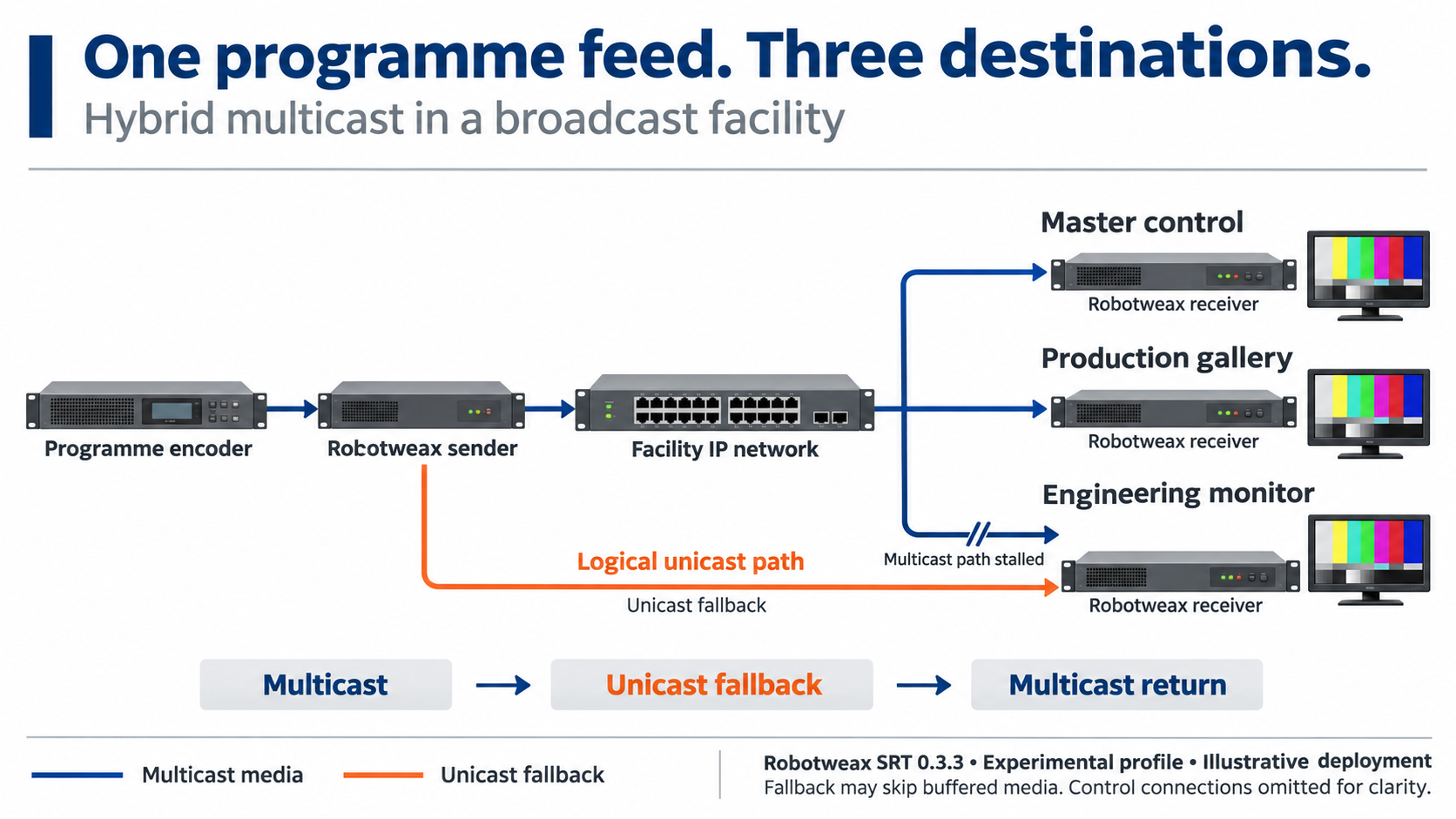
A shared programme feed can reach several destinations efficiently over multicast, yet individual receivers can experience different delivery conditions. Master control and the production gallery may receive normally while an engineering monitoring receiver stops seeing multicast packets. If that receiver can still reach the sender over unicast, recovery can be handled per receiver while the shared feed continues.
Robotweax SRT 0.3.3 provides an experimental hybrid multicast profile for evaluating this behaviour. This article follows its media path, control decisions and application contracts. The scope is the published 0.3.3 source and sample; the facility shown above is an illustrative deployment to evaluate, not a measured installation.
The media path inside a facility
A programme encoder supplies MPEG-TS datagrams over local UDP to robotweax_srt_multicast. The Robotweax sender distributes original DATA over IPv4 multicast. Each Robotweax receiver forwards recovered media to a local UDP decoder or monitoring application. Per-receiver unicast sessions carry control, key exchange and recovery traffic.
Hybrid operation uses the independent-source, coordinated sender. The fixed multicast source socket is separate from the unicast control sockets. The group owns original transmission, canonical recovery history and bounded send work, rather than leaving multicast original pacing to an elected receiver connection.
This separation does not create physical redundancy. A unicast delivery policy cannot repair a disconnected receiver or a shared link failure that blocks both paths. The useful case is a multicast-specific interruption while unicast delivery remains possible. The network still needs a working IPv4 multicast configuration and adequate unicast capacity. Source and sender contracts
Startup: authenticate first, establish delivery, then join multicast
The sample provisions a distinct random 32-byte control secret for each receiver. The sender holds the receiver entries; each receiver receives only its own entry. The receiver ID is bound through Stream ID to the authenticated exchange. Duplicate identities, reused secrets, zero keys and malformed entries are rejected.
Startup authenticates both peers and confirms unicast delivery before exposing the receiver as ready. Applications should wait for media_ready before feeding MPEG-TS. Multicast joining and membership recovery then proceed through bounded operations.
Control authentication and media encryption are separate. Pairwise credentials authenticate the hybrid exchange. A media passphrase and the selected CTR or GCM mode govern payload encryption. Without a media passphrase, the control exchange is authenticated but the media remains cleartext. Shared media keys retain their shared-group trust limitations; per-receiver control credentials do not make each holder unable to impersonate a media sender. Sample setup and credentials
Detecting a stalled receiver
A quiet socket alone does not establish multicast failure: the encoder might have stopped producing media. The detector combines fresh authenticated progress reports with validated local DATA observations and confirmed policy state. Source activity reports advance only when media is actually admitted.
Detection is separate from the controller that requests a transition. A stall assessment does not itself change the media path. The sample explicitly attaches the components needed for automatic fallback and return.
Its documented LAN demonstration settings assume at most 50 ms one-way transit, a 300 ms stall interval and 500 ms sustained recovery. These are configured assumptions, not measured network bounds or guaranteed switching times. Sampling, control exchange, queueing and replay add work beyond the detector interval. A deployment must choose timing against its network and remaining playback slack. Detection and control design
Fallback and return are confirmed policy changes
When multicast stalls, the receiver can request unicast originals. The sender checks authorization, policy revision, retained history, deadlines and budget before accepting the change. Multicast can continue serving other receivers throughout.
Returning requires more than seeing a few packets again. The sender establishes an overlap window at an actual admission boundary B, while unicast originals continue. The receiver must establish contiguous validated multicast coverage over [B, C) under the matching revision and generation. A high sequence number alone does not prove that every packet in that interval arrived.
The sender validates the coverage, its freshness and the overlap window before committing multicast return. If the overlap expires first, the policy returns to unicast and retains its reservation. Expiry does not silently select multicast.
| Confirmed mode | Meaning for evaluation |
|---|---|
unicast |
The receiver’s original delivery uses unicast; other receivers may still use multicast. |
overlap |
Unicast remains available while multicast coverage is established for the return decision. |
multicast |
The multicast policy has been confirmed; receiver-specific control and recovery still exist. |
Use hybrid_path events to observe confirmed modes. A request or detector event is not evidence that a transition completed. Overlap and return
Why fallback can interrupt decoded pictures
The sample implements a live catch-up policy. At fallback, the host discards unread local media up to its last validated DATA position, including gaps in that prefix. That locally applied discard becomes the merge cursor. This avoids asking the sender for already-acknowledged data that may no longer exist in its recovery history. A remote progress report does not authorize the local discard.
hybrid_discontinuity reports cumulative skipped sequence positions. Remaining datagrams retain their bytes and order, but the decoder may show a gap or wait for its next video keyframe. A restored transport path therefore does not establish uninterrupted decoded video.
Evaluate the encoder’s GOP structure, decoder recovery and end-to-end output as well as transport logs. Sender history, delivery deadlines and admission budgets can still prevent a transition. The sample makes no hitless or lossless failover claim.
Capacity, queueing and finite control budgets
The coordinated sender requires a positive SRTO_MAXBW; the sample exposes this as --hybrid-maxbw, defaulting to 1,000,000 bytes/s. Account for DATA headers, encryption tags and IP/UDP overhead when setting a wire budget. An application send succeeds when bounded group work accepts the message, before actual UDP submission or receiver delivery.
The sender has a 64-frame queue and permits at most 64 receiver members, including detached members. Separately, the hybrid sample’s credential configuration accepts up to 16 receiver entries. These are different limits, and neither is a throughput qualification at maximum fan-out. Shared multicast repair aggregation is disabled for this profile; --repeat-threshold must remain zero.
Canonical unicast DATA repairs share an aggregate wire limit of four times SRTO_MAXBW, in addition to member pacing and flow limits. Hybrid full-stream fallback and overlap also require their applicable recipient and wire-budget admission. The repair cap is not a promise of spare capacity for arbitrary numbers of fallback streams or fair bandwidth per receiver.
Automatic control work is finite. --hybrid-cycles permits 1–8 operations per controller, default 4; the initial return consumes a return operation. Exhaustion stops new automatic requests and leaves the last committed policy in place. Credentials also expire after the configured run and setup allowance. The sample requires restart with new credentials or budgets for another run.
Building and evaluating the sample
From a checkout of v0.3.3, with its documented build dependencies installed, the source guide uses:
cmake -S . -B build-hybrid-media -DCMAKE_BUILD_TYPE=Release \
  -DBUILD_SHARED_LIBS=OFF -DROBOTWEAX_SRT_BUILD_EXAMPLES=ON \
  -DROBOTWEAX_SRT_ENABLE_EXPERIMENTAL_ACP1=ON \
  -DROBOTWEAX_SRT_ENABLE_EXPERIMENTAL_HYBRID_CONTROL=ON \
  -DENABLE_AEAD_API_PREVIEW=ON
cmake --build build-hybrid-media --parallel --target robotweax_srt_multicast
These are the documented build commands, not a new qualification run for this article. Follow the versioned media guide for credential provisioning and sender/receiver commands. Its loopback addresses and TTL zero deliberately keep that example local; a facility trial needs explicit interface, address, routing and multicast configuration.
A useful evaluation proceeds in stages:
- Establish a continuous MPEG-TS source and verify authenticated readiness and normal multicast reception.
- Interrupt multicast to one receiver while preserving its unicast connection. Record requested and confirmed transitions separately.
- Inspect
hybrid_statsfor outcomes, budget exhaustion and locally observed packet counts; inspecthybrid_discontinuityand decoded output together. - Restore multicast and verify the overlap and confirmed return. Repeat under realistic loss, timing and decoder conditions.
- Test credential expiry, finite operation budgets and several affected receivers. Measure wire traffic and decoder recovery rather than inferring them from configuration.
The shipped sample does not include the test suite’s outage-injection option. Published tests cover controlled scenarios; they do not establish behaviour on every physical multicast/IGMP network.
Integration scope
Hybrid control in 0.3.3 is a default-off experimental profile for Robotweax peers. The sample requires a static build and matching internal source interfaces; there is no public hybrid C API. It remains outside the supported security and Haivision interoperability scope.
For a broadcast team, the concrete evaluation is receiver-specific recovery while multicast continues for the rest of the facility. Its acceptance criteria should include both network behaviour and the actual pictures and sound delivered after a transition.
Download Robotweax SRT 0.3.3 · Release overview · Feature comparison