
Robotweax SRT 0.3.2 introduces SRT MultiCast, a transport feature that distributes a stream to multiple receivers while sending each original payload only once over UDP multicast. The release also adds opt-in ARQ-first FEC, improves timestamp correction and listener admission, and provides a recipe for building srt-live-transmit against the Robotweax SDK. Release announcement
Robotweax SRT is an independent C++20 implementation of Secure Reliable Transport with Haivision SRT API 1.5.7 compatibility.
Introducing SRT MultiCast
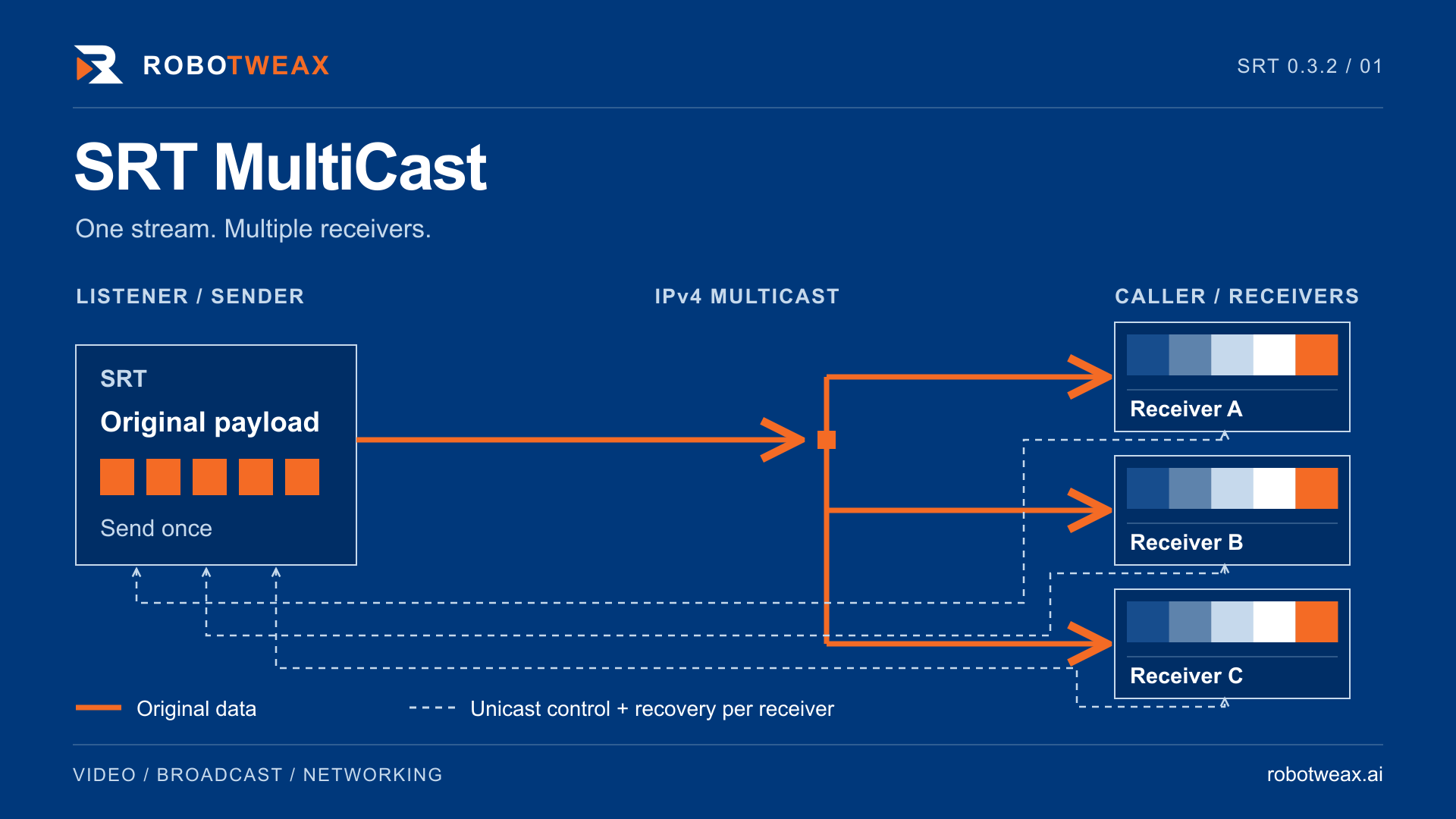
Conventional unicast distribution requires the sender to transmit a separate copy of a stream to each receiver. SRT MultiCast introduces a different topology: one Listener sender distributes original payload over IPv4 multicast, while multiple Caller receivers maintain individual unicast connections for control and recovery.
This separates shared data distribution from receiver-specific transport state. The network distributes multicast originals to participating receivers, while each receiver retains its own recovery connection to the sender. An optional shared-loss repair policy can also send repairs over multicast when its configured threshold is reached. Multicast architecture
The initial feature supports Robotweax-to-Robotweax groups with shared CTR or GCM encryption.
A practical multicast application
The new robotweax_srt_multicast example connects UDP MPEG-TS sources to multiple receivers using the public <srt/srt.h> API. A source such as FFmpeg or a hardware encoder supplies local UDP datagrams. The sender distributes them through SRT MultiCast, and each receiver forwards the recovered media to a local UDP player.
ARQ-first FEC makes redundancy conditional
Version 0.3.2 introduces ARQ-first as a regular opt-in sender policy for supported Live Matrix FEC connections.
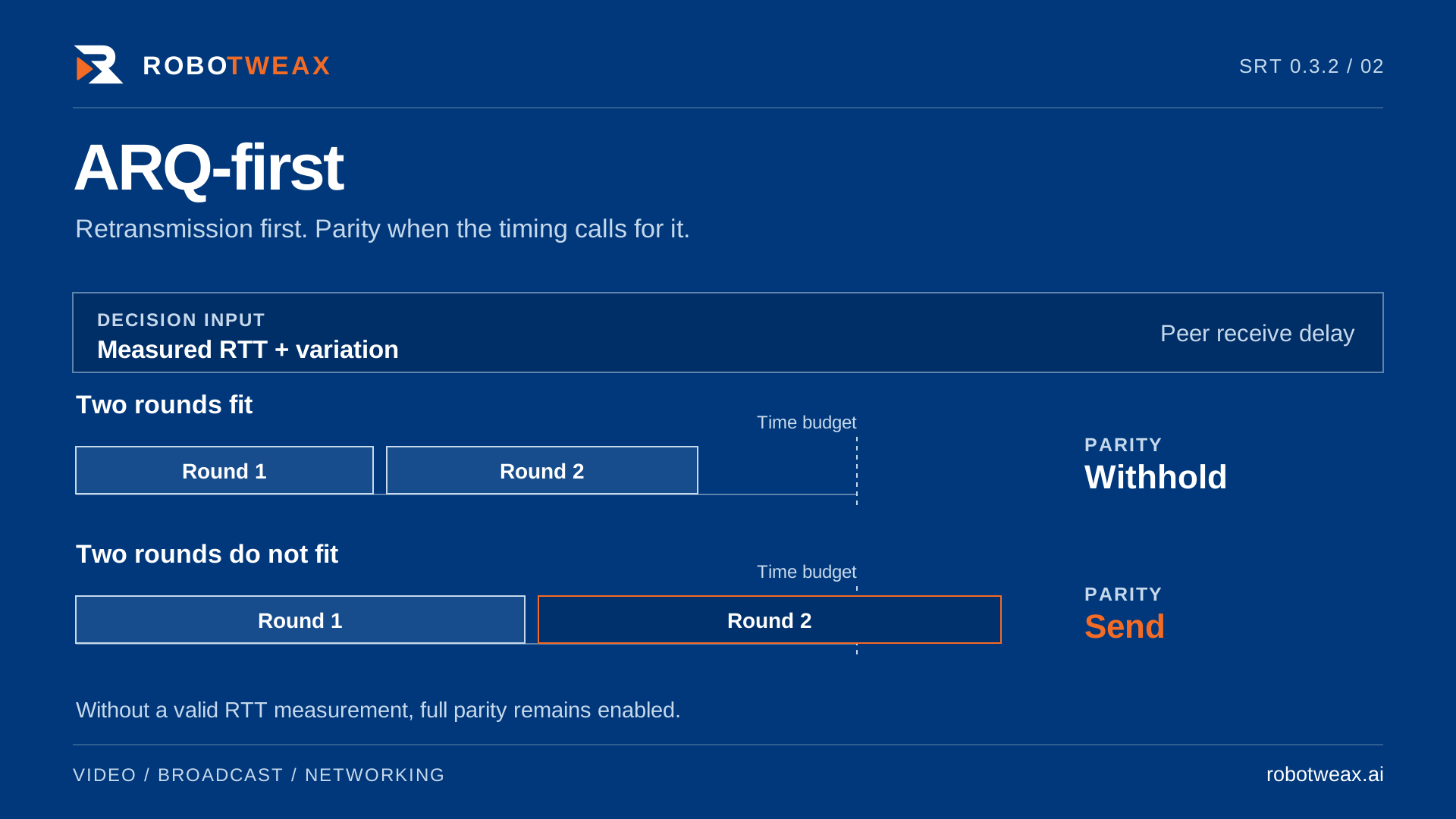
Forward error correction sends redundant information that can reconstruct lost packets. Automatic repeat request, or ARQ, recovers losses through retransmission. ARQ-first uses the available recovery time to decide whether a ready FEC repair packet needs to be transmitted.
The sender evaluates measured round-trip time and its variation. If two retransmission rounds can fit within the peer’s receive delay, it withholds the ready parity packet. Otherwise, it sends parity. Until a valid RTT measurement exists, full parity remains enabled.
This allows connections with sufficient recovery time to avoid some proactive redundancy. The benefit depends on receive latency, network timing, loss conditions and workload; the release makes no universal bandwidth-saving or delivery-deadline claim. ARQ-first policy
The policy requires Live transmission, TSBPD, the live congestion controller and a compatible Matrix FEC filter with arq:always and at least two rows. It applies to supported individual Caller/Listener sockets.
Existing applications retain always-on parity unless they explicitly enable ARQ-first. The setting is local to the sender and introduces no new handshake field or filter-string key.
Evaluating ARQ-first through srt-live-transmit
An optional recipe builds the pinned Haivision srt-live-transmit application against an installed Robotweax SDK. The executable is named srt-live-transmit-robotweax, allowing it to coexist with a regular Haivision installation.
The adapted application accepts arqfirst=yes in SRT output URIs. Unless a compatible packet filter is supplied explicitly, this selects an 8×8 Matrix FEC configuration with arq:always.
For example, a sender can forward incoming UDP traffic using:
srt-live-transmit-robotweax \
  'udp://127.0.0.1:5000' \
  'srt://127.0.0.1:9000?mode=caller&latency=120&arqfirst=yes'
The recipe builds the application against Robotweax’s transport library. Functional checks cover Linux, macOS and Windows, including controlled packet loss, encrypted delivery and reversed Caller/Listener roles. It remains an explicit local evaluation workflow: the normal library build does not fetch the application, and the recipe does not publish an application installer. Application recipe and tests
More accurate timing during startup
Timestamp-Based Packet Delivery, or TSBPD, schedules delivery using packet timestamps and the configured delay. Its drift correction needs to account for changing path delay without confusing that change with clock drift.
Version 0.3.2 distinguishes a measured RTT from the estimator’s initial default. Drift sampling continues while RTT is unavailable, but the RTT correction term is applied only when a valid measurement exists. This prevents an artificial startup value from influencing the path-delay correction. Timing implementation
Compatibility and deployment
The release keeps project, ABI and API versions separate:
| Component | Version or contract |
|---|---|
| Robotweax project release | 0.3.2 |
| Shared-library ABI | 0.3 |
| Compatible Haivision SRT API | 1.5.7 |