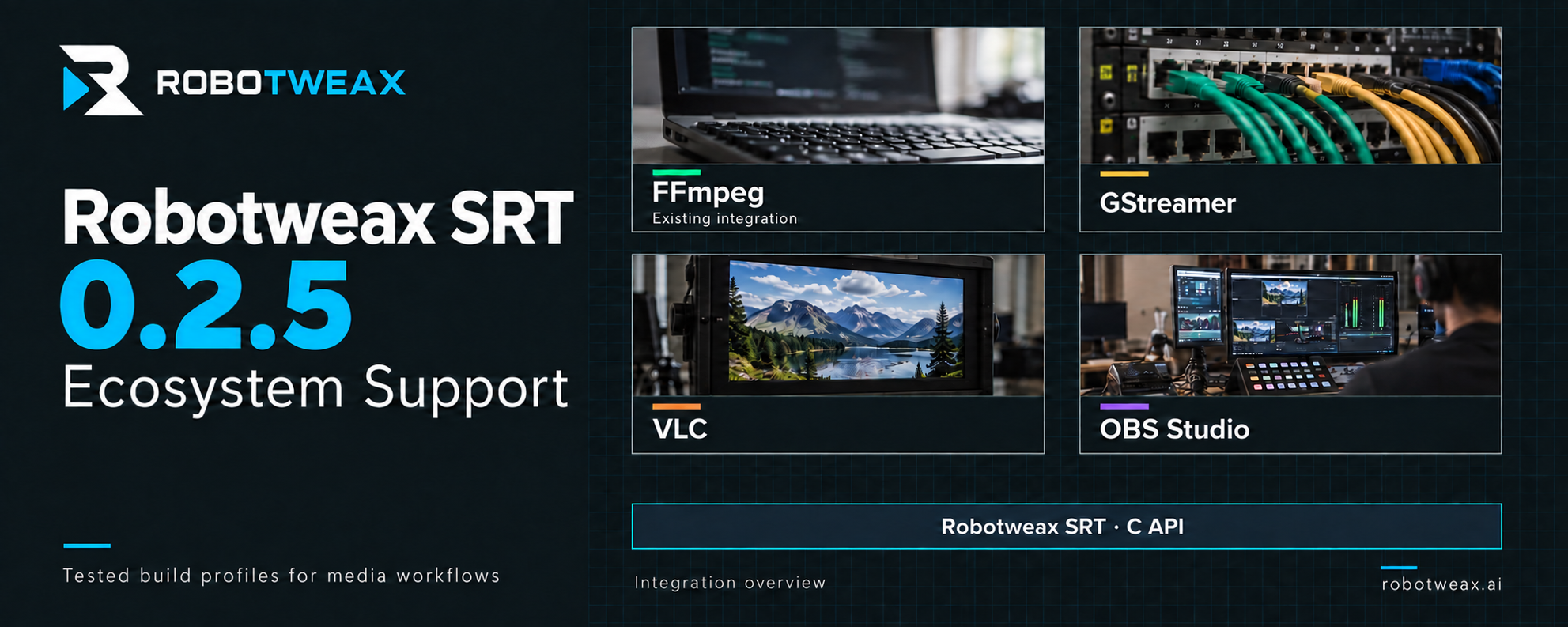
Robotweax SRT 0.2.5 puts integration with existing media applications at the centre of the release. With its “Ecosystem Support” focus, the published version expands the documented and automatically tested build profiles for GStreamer, VLC and OBS Studio. Developers and integrators gain practical ways to evaluate the independent SRT implementation in their own streaming, broadcast and media workflows.
Version 0.2.5 was published on 23 September 2026. The release page includes the SDK installers and documents the release artifact checks.
More Integration Options for Familiar Media Applications
The existing FFmpeg integration provides part of the foundation. Version 0.2.5 extends this approach to additional applications, documenting the source revisions, build steps and tested use cases for each integration.
GStreamer: The existing srtsrc and srtsink elements can use Robotweax SRT without modifying the GStreamer plugin. The tested Linux profile for GStreamer 1.28.7 covers sending and receiving in Caller/Listener configurations, cleartext and AES-128-CTR-encrypted transport, and media and reconnect checks. This gives developers a way to evaluate Robotweax SRT within familiar GStreamer pipelines.
VLC: A documented Linux build based on a pinned VLC 3.0.24-rc1 source revision enables evaluation of SRT input and output. Tests cover MPEG-TS with MPEG-2 video, including decoded frames and outgoing media. The profile runs without a graphical interface and requires a small, documented payload-option adjustment. Audio and other platforms are outside the scope of this qualification.
OBS Studio: Tested module and desktop build profiles for OBS Studio 32.2.2 cover Linux, Windows x64 and macOS on Apple Silicon. They connect native SRT output and FFmpeg media input to Robotweax SRT as the selected transport library. Desktop checks include encrypted transport in both directions and automatic reconnection. The build recipes include a targeted MPEG-TS lifecycle correction. The Windows profile uses the still-experimental BCrypt backend; Linux and macOS use OpenSSL.
Checking Media and Verifying Library Selection
A successful connection alone does not establish that a media workflow works. The integration profiles therefore also check transmitted or decoded media: video and, where included in the profile, audio. These checks are complemented by tests for encryption, shutdown and reconnection.
The recipes also verify that the application actually uses the intended Robotweax library. This helps make evaluations reproducible in environments with multiple SRT installations.
Targeted Transport and Diagnostic Improvements
Version 0.2.5 fixes several edge cases in transport behaviour. These include delayed loss reports, selection of usable UDP buffer sizes and receive-window management. Optional Linux sender diagnostics also help distinguish locally abandoned retransmissions from actual receiver delivery loss.
For the separate OpenSSL and BCrypt Windows SDK variants, the build pipeline has been extended with signing and signature checks. The signed SDK installers are available with the release; the release page documents the build and signature checks.
A Clearly Documented Evaluation Scope
Robotweax SRT remains an independently developed protocol library with an SDK and integration recipes. The new profiles apply to specific application versions and build configurations; ready-made Robotweax distributions of OBS Studio or VLC are not part of the release.
The public SRT API target remains 1.5.7, and the shared-library ABI line remains 0.2. Robotweax SRT is still a pre-1.0 project. The documented tests do not replace validation of a deployment’s own workflow under its intended network and operating conditions.
Prepare your integration: The 0.2.5 release notes and integration matrix describe the build profiles, prerequisites and limits for your evaluation.