
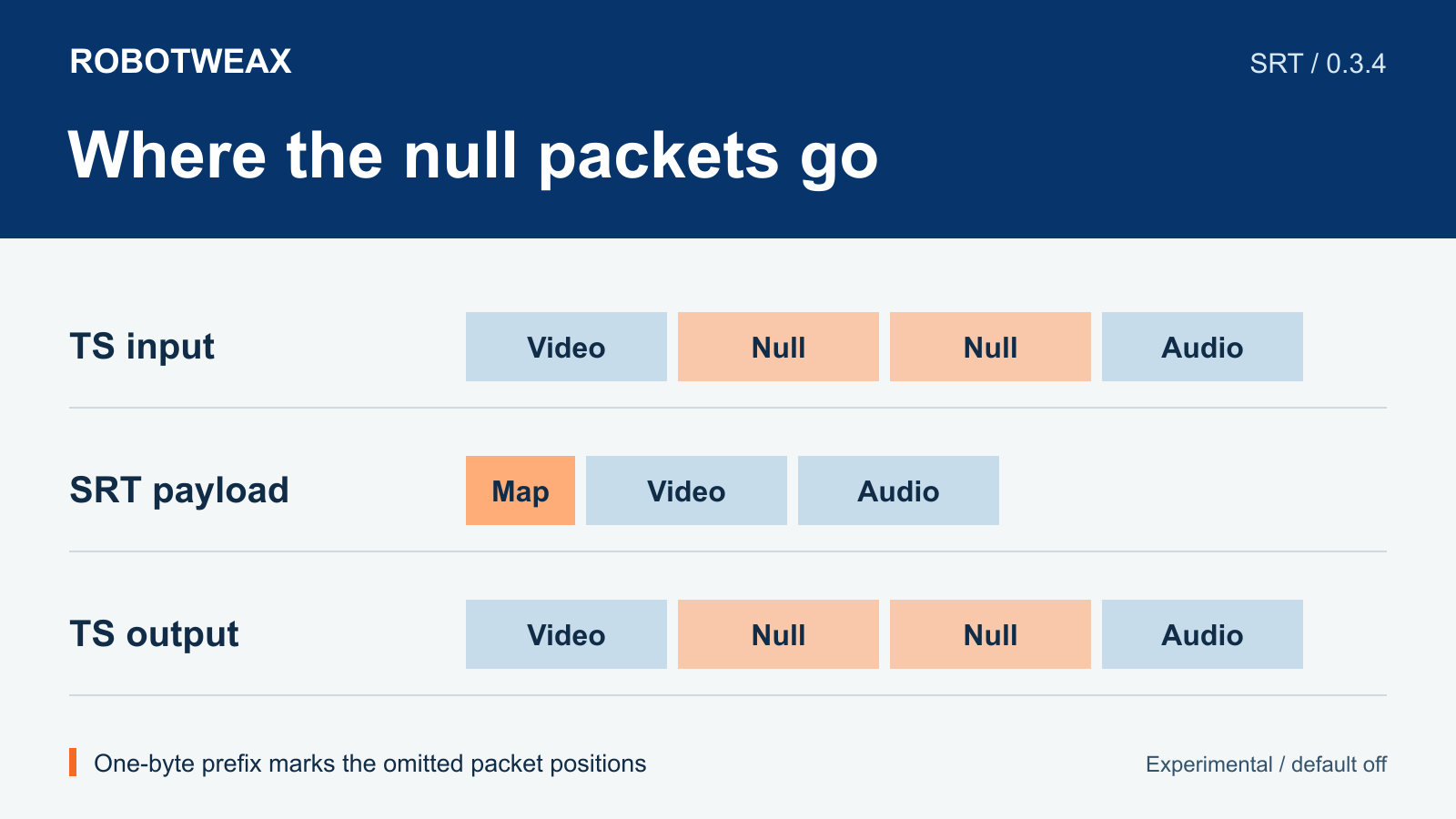
A constant-bitrate MPEG transport stream uses null packets to fill the space between programme packets. On a contribution link, that stuffing consumes bandwidth. Robotweax SRT 0.3.4, released on 20 November 2026, introduces an experimental option called null packet deletion (NPD). Two compatible endpoints can omit canonical null packets on the link and reconstruct the original stream at the receiver.
What crosses the link
Consider a message containing a video packet, two canonical null packets and an audio packet. With NPD active, the sender puts a one-byte deletion map ahead of the video and audio packets. The map tells the receiver where to put the two null packets back. All four reach the receiving application in their original order, byte for byte. The message boundary and timestamp stay intact. Every SRT DATA packet is still sent.
The amount saved depends on how much eligible stuffing the stream contains. Payloads that do not align to MPEG-TS packets pass through unchanged. Engineers evaluating a feed can read the NPD counters for deleted and restored units. The published test scope still leaves deployed transport streams and pacing on physical networks to be qualified.
NPD ships switched off. It requires matching Robotweax endpoints on individual Live Caller/Listener sockets. A listener configured with IF_OFFERED can also accept an ordinary SRT caller. A caller configured with REQUIRED ends setup if the peer cannot negotiate NPD. Null packet deletion and peer compatibility
Waking a receiver and sizing a group
A receiver application can now ask a worker thread to leave an SRT epoll wait while keeping its sockets open. The new robotweax_srt_epoll_wake(eid) call applies to both wait variants. Ready events take priority. With no events pending, the wait returns the same value as a timeout, so the worker should check its application state before deciding whether to continue.
For operators using connection groups, the upgrade introduces a limit of 64 members per group by default. Pending connections count alongside connected members. If a deployment needs a larger group, set ROBOTWEAX_SRT_MAX_GROUP_MEMBERS when building the library.
Release and upgrade details
Version 0.3.4 keeps shared-library ABI 0.3 and targets SRT API 1.5.7. The epoll wake call brings the export count to 86. Use matching headers and library for the new call and socket options. The release also hardens connection setup and file receive, and reduces polling on sparse traffic. The published measurements cover specific workloads.
Two further experiments ship disabled by default. One adds peer authentication with pinned P-256 keys on OpenSSL builds, with independent cryptographic review still pending. The other batches UDP datagrams on Linux, with a separate build option for UDP segmentation.
Download the release and signed Windows SDKs · Read the full release notes · Compare Robotweax SRT and Haivision SRT